CAC Reduction Crucial for eCommerce in 2026
CAC reduction is crucial because the competitive landscape in eCommerce is intensifying, making every ad dollar count more than ever. High customer acquisition costs erode profit margins and limit scalability, especially for businesses reliant on paid advertising.
The Escalating Cost of Paid Ads
The cost of paid advertising on platforms like Meta, Google, and TikTok continues to rise, driven by increased competition and algorithmic shifts. Advertisers are forced to bid higher for ad placements, making it imperative to maximize the effectiveness of each impression. Without optimized creatives, budgets are quickly depleted, leading to unsustainable growth. For more insights into ad efficiency, consider reading about how to reduce CAC using UGC content in dropshipping.
The Role of Trust and Authenticity
Consumers in 2026 are highly skeptical of traditional advertisements, prioritizing authenticity and social proof. Content that feels genuine and relatable fosters trust, which is a powerful driver of conversion and significantly lowers the psychological barrier to purchase. UGC, by its nature, embodies this authenticity.
How Market Saturation Impacts CAC
Market saturation means more brands are vying for the same customer attention, pushing CAC upwards. Differentiating your brand requires more than just a good product; it demands compelling, varied, and authentic content that resonates deeply with target audiences. AI UGC helps cut through the noise by delivering hyper-relevant visuals at scale.
AI-Generated UGC and How Does It Differ
AI-generated UGC refers to authentic-looking content, such as lifestyle images and videos featuring products in real-world scenarios, created using artificial intelligence. It differs from traditional content by offering unparalleled speed, scalability, and cost-efficiency without sacrificing the relatable feel of genuine user content.
Defining AI-Powered UGC for eCommerce
AI-powered UGC for eCommerce involves using advanced AI models to generate visual assets that mimic authentic user-created content. This includes placing your products into diverse, realistic scenes with models, creating varied backgrounds, and producing content optimized for different platforms and ad formats. This approach is key for UGC content dropshipping in 2026.

Specialized AI vs. Generic Foundation Models
Specialized AI tools are designed specifically for eCommerce content generation, offering precision in product rendering and scene composition, unlike generic foundation models. While tools like Midjourney, Stable Diffusion, or DALL-E can generate impressive images, they often require extensive prompt engineering, multiple iterations, and manual fixes to achieve ecommerce-ready quality, especially concerning product geometry, realism, placement, and consistency. Specialized platforms, such as My UGC Studio, streamline this process, ensuring consistent, high-quality results suitable for production.
The My UGC Studio Advantage
My UGC Studio leverages proprietary AI to produce hyper-realistic, on-brand UGC rapidly and at a fraction of the traditional cost. Our platform eliminates the guesswork and manual effort associated with generic AI, providing a streamlined workflow for generating diverse creative assets optimized for conversion. This ensures that every piece of content directly contributes to lowering your CAC.
AI UGC Directly Lower Customer Acquisition Cost
AI UGC directly lowers CAC by enhancing ad performance, increasing conversion rates, and drastically reducing content production expenses. It creates a positive feedback loop where better-performing ads cost less to run and convert more effectively.
Boosting Ad Engagement and CTR
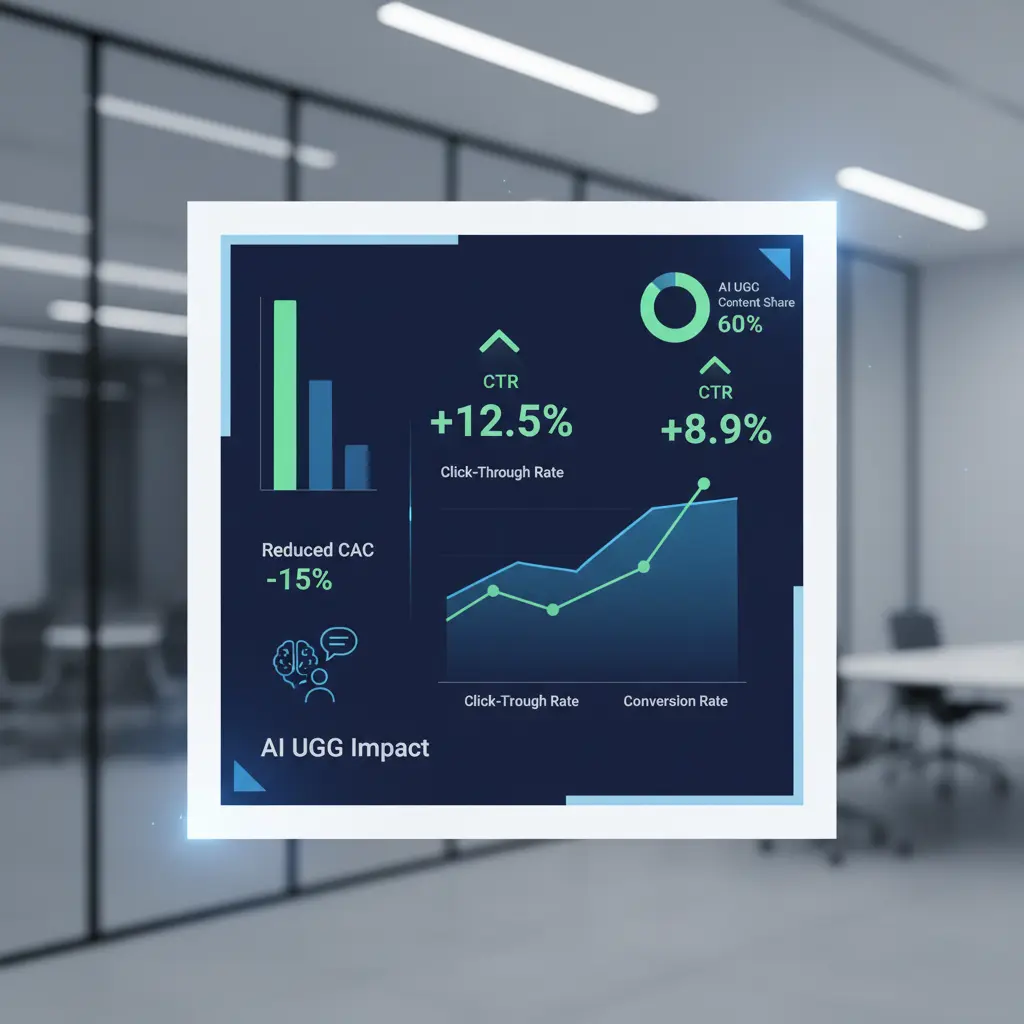
Authentic-looking AI UGC significantly increases click-through rates (CTR) and overall ad engagement. Ads featuring relatable content capture attention more effectively than polished, generic stock photos. Higher CTRs lead to better ad quality scores, which in turn reduces the cost per click and cost per impression, a critical aspect of UGC ads for TikTok Shop and other platforms. To maximize this, follow these steps:
Identify high-performing UGC themes: Analyze existing data to understand which types of AI-generated UGC (e.g., specific scenarios, models, emotions) resonate most with your audience.
Generate variations for A/B testing: Use your AI platform (like My UGC Studio) to create multiple versions of top-performing themes, varying elements like background, product placement, or model expressions.
Launch and monitor split tests: Deploy these variations across your ad platforms and track CTR, engagement rates, and conversion metrics rigorously.
Scale winning creatives: Allocate more budget to the AI UGC assets that demonstrate the highest engagement and lowest CAC, while continuously refreshing with new variants.
Enhancing Conversion Rates on Product Pages
UGC visuals on product pages build trust and provide social proof, directly leading to higher conversion rates. When potential customers see products used by "real" people in everyday settings, it helps them visualize themselves using the product, overcoming purchase hesitations. This is vital for Shopify product page images with AI in 2026.
"Authenticity isn't just a buzzword; it's the currency of conversion in 2026. AI-powered UGC delivers that authenticity at a scale previously unimaginable, making every marketing dollar work harder."
Reducing Content Production Expenses
AI UGC drastically cuts the financial and logistical burden of content creation, freeing up budget for ad spend. As per our product knowledge, a traditional 30-item shoot costs over $4,500, while an AI strategy can cost around $80. This allows businesses to reinvest those significant savings directly into scaling their ad campaigns, leading to more impressions and conversions without increasing overall marketing outlay. Learn more about how to cut Shopify content costs by 90% with AI.
The Key Benefits of AI UGC for Ad Campaigns
AI UGC offers numerous benefits for ad campaigns, including rapid iteration, hyper-personalization, and improved ad relevancy, all contributing to lower CAC.
Rapid Iteration and A/B Testing
AI enables the rapid generation of hundreds or thousands of unique ad creatives, facilitating extensive A/B testing to identify top performers. This iterative process allows marketers to quickly optimize campaigns, allocate budget to the most effective visuals, and continuously refine their strategy for maximum ROI. This is a core component of AI creative testing for eCommerce ads.
Personalization at Scale
AI UGC allows for the creation of highly personalized ad creatives tailored to specific audience segments, demographics, or even individual users. This level of personalization makes ads far more engaging and relevant, significantly increasing their effectiveness and reducing the cost of acquiring interested customers.
Improved Ad Relevancy and Quality Scores
Ad platforms reward highly relevant and engaging content with better quality scores, leading to lower ad costs and broader reach. AI-generated UGC is inherently designed to be relevant and engaging, helping campaigns achieve higher quality scores, which directly translates to a reduced CAC.
A Practical Workflow for Implementing AI UGC
A practical workflow for implementing AI UGC involves three key steps: defining content strategy, leveraging a specialized AI platform, and deploying/optimizing performance.
Define Your Content Strategy
Defining your content strategy involves clearly identifying your target audience, key selling points, and the natural scenarios for your product. This initial planning prevents aimless content generation by considering different emotions, settings, and demographics you want to portray.
Leverage a Specialized AI UGC Platform
Leveraging a specialized AI UGC platform, such as My UGC Studio, allows you to upload product images and provide descriptive prompts to generate a wide array of lifestyle images and videos quickly. Focus on diversity in models, backgrounds, and user interactions to ensure broad appeal. For a detailed guide, see AI UGC Generator for Shopify: Complete 2026 Buyer Guide.
Deploy, Test, and Optimize AI UGC
Deploying, testing, and optimizing AI UGC involves integrating the generated content into ad campaigns, continuously monitoring KPIs, and using A/B testing to identify top performers. This iterative process ensures you scale UGC content in dropshipping with AI without wasting ad budget by refining creatives based on data until optimal results are achieved.
AI UGC Compare to Traditional Content Creation Costs
AI UGC offers a stark contrast to traditional content creation in terms of cost and speed, providing significant savings and faster time-to-market.
The "Content Tax" Eliminated
The concept of a "content tax" – the high recurring cost of producing fresh, diverse content – is virtually eliminated with AI UGC. Traditional methods involve expensive photo shoots, model fees, location rentals, and post-production, summing up to thousands of dollars per campaign. With AI, these overheads are drastically reduced.
| Aspect | Traditional Content Creation (e.g., 30 items) | AI UGC Generation (e.g., 30 items) | Savings |
|---|---|---|---|
| Cost Estimate | $4,500+ | ~$80 | ~$4,420+ |
| Time to Deliver | Weeks to Months | Hours to Days | Significant |
| Scalability | Limited, high cost per variant | High, low cost per variant | Excellent |
| Diversity of Assets | Moderate, expensive to vary | Extensive, easy to vary | Substantial |
Long-Term ROI from AI Investment
The long-term return on investment (ROI) from AI UGC is exponential, as initial setup costs are minimal compared to ongoing content needs. By continuously generating high-performing, fresh creatives, brands can sustain lower CACs, drive consistent conversions, and free up significant budget to reinvest directly into scaling their advertising efforts. This is essential for any brand looking to optimize its overall marketing spend in 2026 and beyond.
Case Studies: Brands Successfully Reducing CAC with AI UGC
Numerous brands are already seeing significant CAC reductions and improved ROI by integrating AI UGC into their marketing strategies.
Dropshipping Success Stories
Dropshippers have particularly benefited from AI UGC, which allows them to test countless product variations and ad angles without inventory or elaborate photoshoots. Brands using platforms like My UGC Studio have reported 20-measurable lower CAC for new product launches and sustained higher conversion rates due to the ability to quickly generate diverse, niche-specific creatives. This enables rapid market testing and scaling for products, directly contributing to profitability. Discover more about UGC content in dropshipping 2026.
Shopify Store Growth
Shopify stores, from startups to established brands, are leveraging AI UGC to revitalize their product pages and ad campaigns. By refreshing visuals frequently with AI-generated lifestyle content, these stores are seeing increased engagement, longer dwell times, and a measurable uplift in add-to-cart and purchase rates. The ability to create stunning, diverse visuals quickly helps these stores to scale their Shopify brand with AI UGC, maintaining a fresh and engaging online presence without breaking the bank.
The Future Trends for AI UGC in CAC Optimization
The future of AI UGC in CAC optimization points towards hyper-personalization, advanced AI-driven audience segmentation, and increased transparency in content creation.
Hyper-Personalized Ad Creatives
Future AI UGC will enable even more granular personalization, delivering unique ad creatives dynamically generated for individual user profiles in real-time. Imagine an AI adjusting a product's color, background, or even the model's ethnicity based on a user's browsing history or demographic data. This level of tailored content will drive engagement to new heights, further lowering CAC.

AI-Driven Audience Segmentation
AI will not only generate content but also intelligently segment audiences and recommend the optimal creatives for each group. This proactive, data-driven approach will remove much of the manual testing burden from marketers, ensuring that the right message reaches the right person at the right time, thereby maximizing ad spend efficiency and dramatically reducing CAC.
Ethical Considerations and Transparency
As AI UGC becomes more sophisticated, ethical considerations and transparency will be paramount. Brands will need to be clear about the use of AI in content creation, fostering trust while still leveraging its efficiency benefits. Future tools will likely incorporate features that help maintain ethical standards and ensure content integrity.