Why are traditional Shopify content costs unsustainable?
Traditional ecommerce photography incurs high recurring overheads for studio space, photography teams, and physical shipping. Coordinating multi-day shoots and manual retouching cycles drains budget and delays product launches.
The Real Cost Breakdown of Physical Shoots
Physical shoots require shipping physical samples and coordinating cast and crew. When products require multi-location shoots, logistics costs and turnaround times quickly accumulate.
Managing Recurring Production Overheads
Unmanaged production expenses silently reduce operating margins on new SKU launches. Continuing to rely exclusively on physical shoots without testing digital workflows can inflate per-image costs significantly.
The Friction of Slow Content Turnarounds
Slow visual production cycles fail to keep pace with rapid catalog updates and channel demands. Relying solely on legacy photo shoots delays ad testing and leads to creative fatigue on social platforms.
What specific costs does AI impact most in content production?
AI tools reduce primary costs associated with physical set builds, talent booking, and manual background removal. These line items traditionally represent the majority of visual asset production spending for ecommerce stores.
Eliminating Physical Location and Studio Costs
Generating lifestyle backgrounds digitally removes the need for physical location rentals and photographer daily rates. Starting from a clean product photo, AI software renders contextual backgrounds around the exact product geometry.
Reducing On-Camera Talent Expenses
Generative model overlays eliminate talent agency fees and recurring usage rights negotiations. Store owners can present products across varied lifestyle scenes without scheduling physical model shoots.
Eliminating Sample Shipping Logistics
Using digital source photos removes sample shipping logistics and turnaround delays. This streamlined process prevents sample damage and speeds up listing creation for international catalogs.
Streamlining Background and Scene Post-Production
Automated background replacement and lighting integration streamline post-production editing. Human review focuses on composition, lighting integration, and scene suitability while My UGC Studio keeps product details, labels, and colors accurate.
How can AI workflows lower production spend?
AI production lowers asset unit costs by replacing physical photography setups with software credit allocations. Moving from physical sets to digital generations shifts production from heavy upfront costs to predictable credit usage.
Understanding Credit Pricing and Usable Output Costs
On My UGC Studio, the Starter plan costs $19/month for 50 credits, making nominal image outputs $0.38 each. Real unit costs depend on acceptance rates; at an illustrative 60% acceptance rate, each usable image costs approximately $0.63 plus inspection labor.
Hypothetical Cost Comparison: 30-Item Catalog Update
A realistic cost comparison highlights the financial difference between traditional physical shoots and AI workflows. Below is a hypothetical cost breakdown comparing physical studio production against an AI-assisted workflow.
| Cost Category | Traditional Physical Shoot (30 items) | AI Workflow (30 items, illustrative math) |
|---|---|---|
| Image Generations | Current quote required; include editing and usage rights | $19 (50 credits on Starter plan) |
| Models & Talent | Current quote required; include editing and usage rights | $0 (Included generative model styles) |
| Shipping & Logistics | Current quote required; include editing and usage rights | $0 (Digital source uploads) |
| Retouching & QA Inspection | Current quote required; include editing and usage rights | Current quote required; include editing and usage rights |
| Staff Time (Est.) | 15-30 hours | 2-4 hours |
| Total Estimated Cost | Current quote required; include editing and usage rights | Current quote required; include editing and usage rights |

Reallocating Production Budget to Paid Acquisition
Savings achieved through digital asset generation can be reallocated directly into ad testing. This strategic shift allows reallocating funds into paid media channels like Meta or TikTok. Learn more about scaling your Shopify catalog with AI product photos.
Can AI workflows reduce physical studio dependencies?
AI workflows reduce dependence on physical studio infrastructure by generating lifestyle imagery from product inputs. Instead of booking studios weeks in advance, merchants generate fresh visual variations on demand.
Shortening Production Cycles from Weeks to Minutes
Traditional photo shoot cycles often take weeks from planning to final deliverables. AI software generates candidate assets in minutes, enabling faster testing cycles.
Accelerating Background Editing and Cleanup
Automated background rendering replaces manual photo compositing. Generative platforms process scene backgrounds rapidly, shifting post-production into a fast inspection step. Explore how to generate UGC images with AI.
"AI generation changes asset creation from an expensive physical project into an efficient software workflow, provided teams maintain thorough quality control."
Advantages of On-Demand Creative Generation
Generating images on demand allows rapid creation of social media and listing graphics. Fast turnarounds help ecommerce stores respond quickly to seasonal demand and trending formats.
How does AI compare to traditional methods in terms of speed and agility?
AI generation produces visual drafts in minutes rather than weeks, allowing rapid creative iteration when backed by clear quality checks.
Accelerating Visual Creation Timelines
Reducing turnarounds from weeks to minutes accelerates visual content creation. Rapid delivery helps maintain continuous visual testing across advertising channels.
Facilitating Creative Testing and Variation
Generating multiple scene variations simplifies A/B creative testing. Comparing performance across diverse variations reveals which visual styles drive clicks.
Adapting Catalog Imagery to Seasonal Trends
Software workflows enable quick visual updates for seasonal promotions. Digital asset generation ensures store catalogs remain current throughout the year.
Increasing Output for Small Teams
Lean teams can manage higher visual output using generative tools. Workflow efficiency allows small brands to scale creative output without hiring external agencies.
How does a zero-shipment workflow operate for digital catalogs?
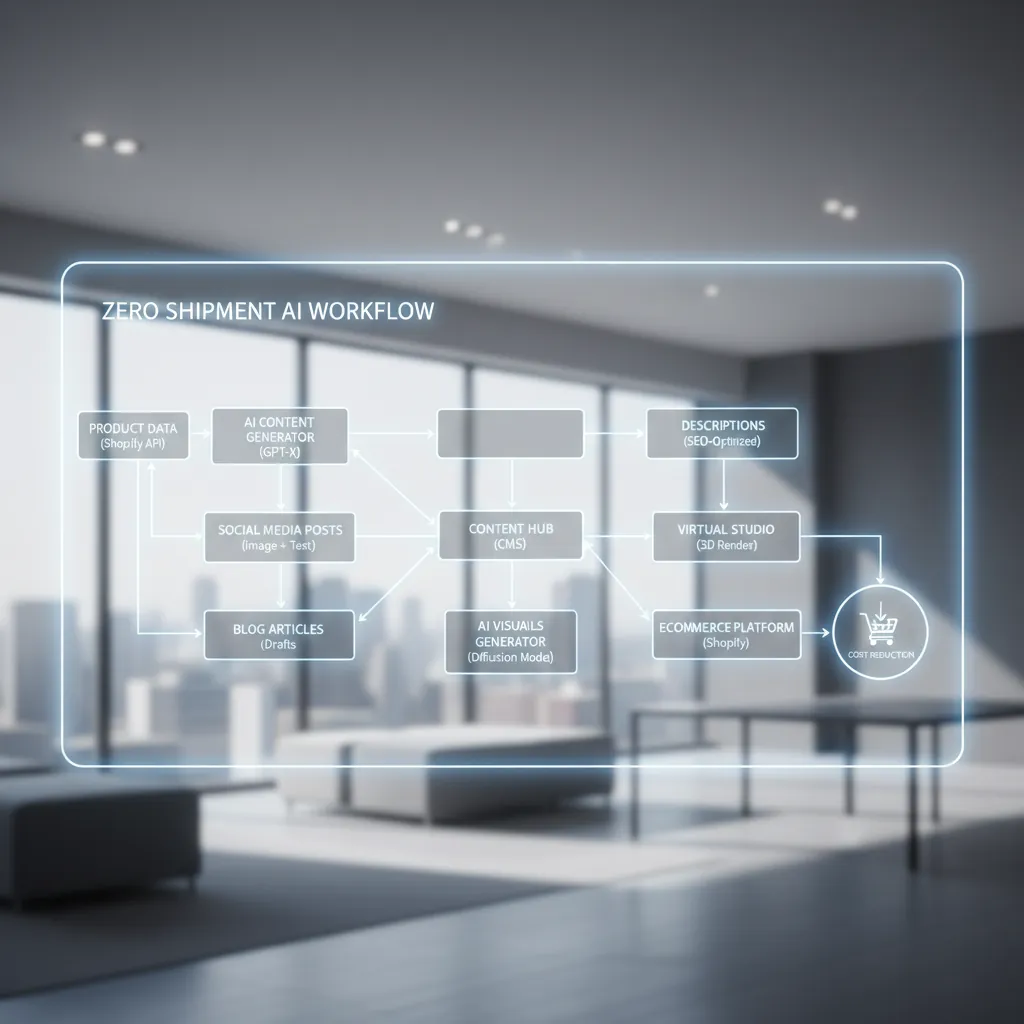
A zero-shipment workflow creates new lifestyle imagery directly from existing digital product photos. By eliminating physical sample shipping, international sellers and dropshippers generate localized listing visuals faster.
Leveraging Digital Source Assets
Digital product photos serve as the base for new visual renders. Clear smartphone photos with readable labels and exact colors provide sufficient input detail.
Localizing Scenes for International Audiences
AI background presets adapt clean product photos for localized target markets. AI toolsets can place clean product shots into localized lifestyle scenes for specific target demographics. Discover how to capture global markets with AI presets.
Streamlining Cross-Border Operations
Cross-border brands reduce supply chain friction in content creation. Localized visual assets can be created and published before physical inventory arrives at regional hubs.
How can Shopify brands implement AI content production today?
Shopify stores can implement AI content tools by connecting catalog platforms and setting QA criteria. Integrating software into existing operations enhances team productivity while maintaining strict visual quality.
A Step-by-Step Implementation Rollout
Implementing an AI content workflow requires systematic steps to ensure cost savings. Follow this structured rollout process:
- Audit Current Content Costs Calculate quarterly spending on studio rentals, photographers, talent fees, and manual editing.
- Map Visual Requirements Identify high-volume visual needs such as ad creatives, catalog refreshes, and social posts.
- Select an AI Platform Choose a tool like My UGC Studio that supports Shopify catalog sync and simple credit pricing.
- Run a 5-SKU Pilot Test 5 SKUs across image and 5-second video outputs to measure acceptance rate, turnaround time, and total usable cost.
- Establish QA Protocols Train staff to inspect generated assets at 100% zoom for overall scene composition and lighting; unlike generic generators that require heavy editing to fix distorted items, My UGC Studio guarantees exact product geometry, label text, and color fidelity.
- Measure True Usable Cost Calculate cost per usable asset: divide subscription spend and QA labor by accepted final outputs, then scale adoption.
Enhancing Team Capabilities with Automation
Equipping existing creative teams with AI tools increases overall asset output. Staff members focus on campaign strategy, messaging, and QA while software handles background rendering.
Selecting the Right Tool for Shopify Workflows
Selecting an AI platform requires evaluating pricing, integration, and output quality. Look for platforms offering direct Shopify catalog import and transparent credit pricing.
What are the operational benefits of AI-generated content beyond cost savings?
Beyond direct savings, AI workflows offer faster content delivery, consistent catalog lighting, and flexible demographic targeting.
Maintaining Catalog-Wide Visual Consistency
AI platforms can apply uniform background styles and lighting to hundreds of product photos. Consistent listing visuals create a polished store appearance and improve customer browsing experience.
Expanding Contextual Model Visuals
Brands can present products across varied lifestyle contexts and demographic settings. Broad demographic representation helps stores connect with wider target audiences.
Tailoring Visual Assets to Specific Customer Segments
Segment-specific ad visuals allow marketers to align lifestyle settings with target buyer preferences. Relevant visual context can increase click-through rates during targeted paid ad campaigns.
Transforming Basic Shots into Contextual Scenes
Simple flat-lay or smartphone photos can be rendered into contextual, high-end lifestyle scenes. Aspirational scene setting elevates perceived brand value without physical set building expenses.
How do you calculate the actual ROI of AI content production?
The ROI of AI content depends on accepted asset yield, ad testing speed, and media spend efficiency. Factoring in retries and QA labor gives store owners a realistic view of creative return on investment.
Sustaining Fresh Visuals for Ad Campaigns
Regularly testing new background variations keeps ad creative engaging for prospective buyers. Rapid iteration allows media buyers to pause fatigue-heavy ads and launch fresh variants.
Evaluating Ad Creative Performance
Short video clips and lifestyle images generated with AI offer flexible creative formats for TikTok and Meta. Iterative testing with fresh AI assets helps identify high-performing creative variations. Understand why AI UGC converts better than studio productions.
Building Creative Advantage Through Launch Speed
Brands that iterate ad creative quickly can discover winning ad hooks before market trends shift. For testing new SKUs, starting from clean digital photos reduces upfront inventory photography expense. Even for dropshipping, unique content from one supplier photo can support quick store launches.

Lowering Cost Per Usable Creative
Cheaper asset creation allows media buyers to test a broader volume of creative variations within fixed budgets. Identifying strong visual concepts earlier helps maintain overall campaign return on ad spend.
How to build an adaptable Shopify content strategy?
To build a future-proof Shopify content strategy, combine AI generation tools with rigorous quality control. Establishing clear QA standards ensures your brand benefits from lower production costs without sacrificing accuracy.
Adapting to Mobile Consumer Preferences
Mobile shoppers require clear, high-resolution product imagery across social channels and store listings. Generative tools enable brands to deliver fresh imagery at the volume needed for social feeds.
Strategic Reinvestment of Content Savings
Directing production savings into paid acquisition allows brands to test ad performance more aggressively. Reinvesting content savings into media testing supports scalable revenue growth. Consider how AI can also optimize your Amazon listing with AI placements.
Integrating AI Tools as Standard Workflow
Adopting digital generation as part of standard catalog management speeds up product launches. Early adopters establish efficient creative workflows that keep overhead low as catalogs expand.
How My UGC Studio Guarantees Product Accuracy and Scene Quality
While ordinary prompt-based generators can alter packaging or logos, My UGC Studio guarantees product accuracy, leaving final review focused on composition and scene fit.
Guaranteed Product Accuracy vs. Generic Generators
Ordinary generative AI tools often distort text, packaging logos, stitching, or item proportions. My UGC Studio solves this core pain point by guaranteeing that the real product stays completely accurate while the background and scene change. With generic tools, operators must reject distorted outputs or rerun prompts repeatedly. My UGC Studio removes this friction by preserving exact product details automatically.
Preserving Brand Guidelines and Text Integrity
Generic generators often require manual compositing or pixel overlays to fix ruined text. My UGC Studio eliminates this extra step by guaranteeing label and packaging fidelity out of the box. By guaranteeing real product accuracy, My UGC Studio lets teams focus entirely on creative scene design and merchandising rather than manual image repair.
Evaluating Scene Composition and Motion
Inspect generated scenes at 100% zoom to evaluate background integration, motion realism in video, and overall aesthetic harmony before publishing.
The Essential Role of Human QA
While My UGC Studio preserves exact product fidelity, human review ensures scene lighting, framing, and channel suitability match brand standards. Clear QA protocols focus review effort on creative merchandising, preventing improper background or channel placements from reaching live stores.