CAC and why is it crucial for dropshipping in 2026
CAC, or Customer Acquisition Cost, represents the total expense required to acquire a new customer, encompassing all marketing and sales efforts. For dropshippers, maintaining a low CAC is paramount to profitability, especially in an increasingly competitive e-commerce landscape.
Defining Customer Acquisition Cost (CAC)
CAC is calculated by dividing your total marketing and sales expenses over a period by the number of new customers acquired during that same period. Understanding this metric helps dropshippers assess the efficiency of their marketing campaigns and overall business health.
The Dropshipping Landscape in 2026
The 2026 dropshipping environment is characterized by intense competition, rising ad costs, and a consumer base desensitized to generic marketing. Authenticity and engaging content, particularly UGC, are no longer optional but essential for standing out and achieving dropshipping success with AI in 2026.
Why a Low CAC is Your Profit Multiplier
A low CAC directly correlates with higher profit margins and increased scalability for dropshipping businesses. By minimizing the cost to acquire each customer, you maximize the lifetime value (LTV) of your customers, allowing for greater reinvestment into product development or market expansion.
UGC specifically lower CAC in dropshipping
UGC lowers CAC by building inherent trust, improving ad relevance, and boosting conversion rates without the high production costs of traditional advertising. Its authentic nature resonates more deeply with potential customers.
Building Trust and Authenticity
UGC acts as social proof, making products more credible and desirable to new customers. People trust recommendations from peers more than branded advertisements, which directly reduces the friction in the sales funnel and the cost of convincing prospects.

Boosting Conversion Rates
Content featuring real users interacting with products inherently increases conversion rates because it allows potential buyers to visualize themselves using the product. This visualization reduces uncertainty and drives purchasing decisions more effectively than polished studio shots.
Reducing Ad Spend Waste with Relevant Creatives
UGC-style assets often perform better in ad campaigns, leading to higher click-through rates (CTR) and lower cost-per-click (CPC). This efficiency means your ad budget reaches more engaged prospects, thus reducing overall ad waste and CAC, as highlighted in strategies for scaling UGC content in dropshipping with AI.
Improving Ad Performance Metrics
UGC consistently outperforms professional studio content in various ad metrics, including engagement, CTR, and conversion rates, especially on platforms like TikTok. This superior performance directly translates to a lower effective CAC.
“Authenticity is the new currency in digital advertising. UGC provides that authenticity in spades, making it an indispensable tool for dropshippers aiming to optimize their ad spend and reduce CAC.”
AI be leveraged for scalable UGC-style asset creation
AI tools empower dropshippers to generate high-quality, diverse UGC-style assets at an unprecedented scale and speed, overcoming the limitations of manual content creation. This scalability is key to consistently feeding marketing funnels with fresh, engaging visuals.
The Power of AI in Generating UGC Assets
AI can generate an endless variety of realistic product images and videos that mimic genuine user content, allowing for rapid iteration and testing. This significantly accelerates the content pipeline, ensuring a constant supply of fresh creatives to combat ad fatigue.
Streamlining Content Workflows with AI Tools
Specialized AI platforms automate many labor-intensive steps in content creation, from background generation to model posing and scene composition. This streamlining dramatically reduces the time and resources needed to produce high-volume, diverse creative assets, making automated UGC pipelines superior to manual ones.
Overcoming Challenges of Generic AI
While general-purpose AI image generators like Midjourney or Stable Diffusion are powerful, they often require extensive prompt tuning and manual fixes to achieve ecommerce-ready quality, especially for product geometry and consistency. Specialized platforms like My UGC Studio are designed to deliver consistent, high-quality product creatives much faster, saving significant time and cost compared to generic AI tools.
Customizing AI-Generated Assets for Brand Voice
Advanced AI allows for fine-tuning the style, demographics, and setting of generated assets to perfectly match a brand's specific aesthetic and target audience. This ensures that even AI-created content feels cohesive and on-brand, enhancing the perception of authenticity.

Effective strategies for implementing UGC in dropshipping campaigns
Effective implementation of UGC involves a multi-pronged strategy that combines sourcing genuine content with leveraging AI for scalable asset generation and strategic deployment across platforms.
Sourcing Authentic UGC from Customers
Encouraging customers to share their experiences through contests, direct requests, or incentivized reviews is an effective way to gather genuine UGC. Displaying this content prominently on product pages and social media amplifies its impact, helping UGC content in dropshipping thrive.
Creating UGC-Style Assets with AI
For products lacking customer content or needing rapid creative variations, AI tools are invaluable for generating realistic UGC-style images and videos. This allows dropshippers to simulate diverse user scenarios and target specific demographics with tailor-made visuals.
Optimizing UGC for Different Platforms
UGC needs to be adapted for the specific requirements and audience expectations of each platform, from Instagram and Facebook to TikTok. For instance, high-converting UGC video ads for TikTok often require a different style and pacing than static images for Instagram.
Integrating UGC into Your Sales Funnel
Strategic placement of UGC throughout the sales funnel—from awareness-building ads to trust-reinforcing product page elements and post-purchase engagement—maximizes its impact on CAC reduction. A comprehensive workflow for Shopify stores ensures seamless integration.
The impact of UGC on CAC be effectively measured
Tracking key performance indicators (KPIs) and conducting A/B tests are essential to accurately measure how UGC influences your CAC and overall campaign effectiveness.
Key Metrics to Track
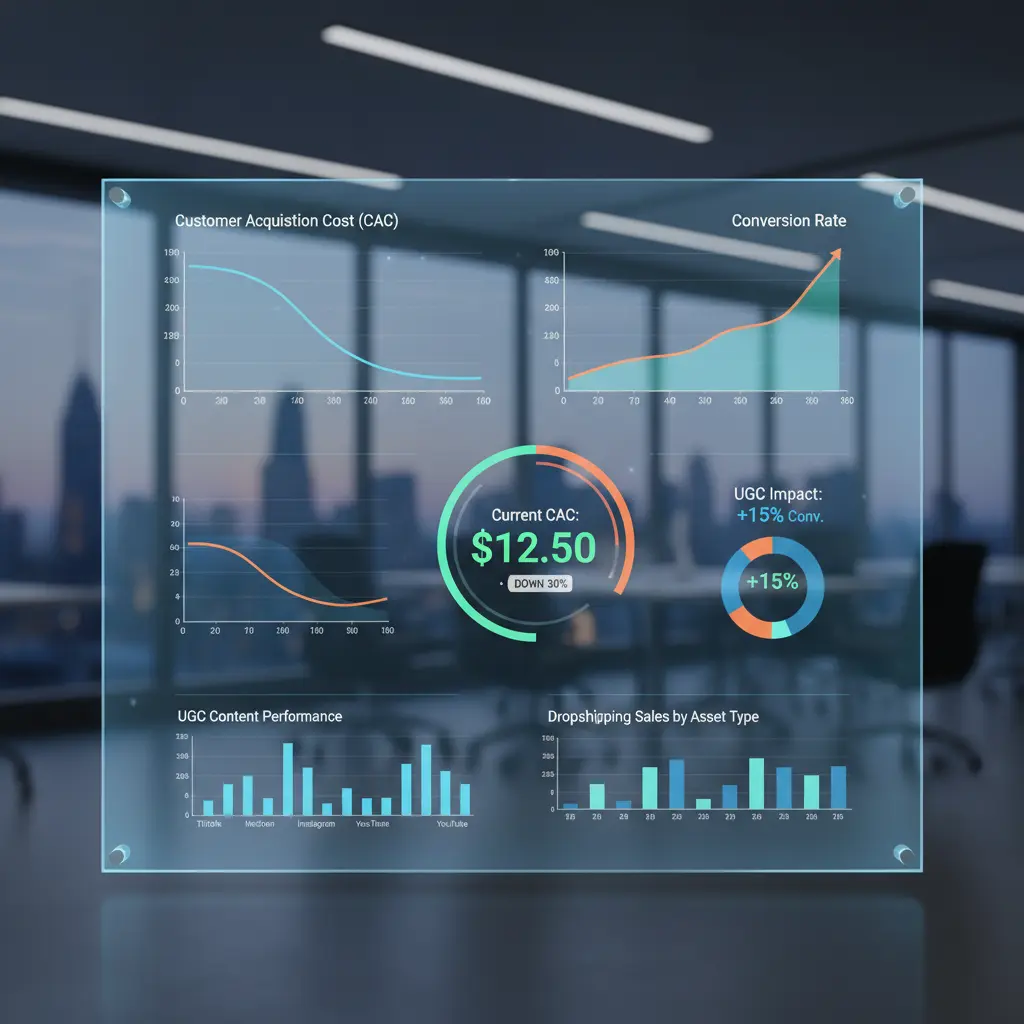
To assess UGC's impact on CAC, monitor metrics such as CTR, conversion rate, cost per lead (CPL), and the overall CAC of campaigns utilizing UGC. Comparing these against benchmarks from non-UGC campaigns provides clear insights.
A/B Testing UGC vs. Traditional Ads
Regularly A/B test UGC creatives against your traditional studio or branded ads to quantify their performance difference. This data-driven approach reveals which content types resonate most with your audience and deliver the lowest CAC.
Calculating ROI for UGC Campaigns
To calculate ROI, compare the revenue generated by UGC-driven sales against the costs associated with producing or acquiring that UGC. This holistic view validates the investment in UGC as a CAC reduction strategy.
| Metric | Traditional Ads | UGC/AI-UGC Ads | Impact on CAC |
|---|---|---|---|
| Click-Through Rate (CTR) | 1.5% - 2.5% | 3.0% - 5.0%+ | Significant Reduction |
| Conversion Rate | 1.0% - 2.0% | 2.5% - 4.0%+ | Moderate to High Reduction |
| Cost Per Acquisition (CPA) | Higher | Lower | Direct Reduction |
| Trust & Authenticity | Low | High | Indirect Reduction (via LTV) |
| Ad Fatigue | High | Lower (due to variety) | Reduced Campaign Longevity Costs |
Common pitfalls should be avoided when using UGC
Dropshippers must navigate potential issues such as inconsistent quality, legal complexities, and over-reliance on uncurated content to maximize UGC's benefits.
Inconsistent Quality and Branding
Unmoderated UGC can sometimes be of low quality or inconsistent with your brand image, potentially harming your brand reputation. Establish clear guidelines for content submission or leverage AI tools that ensure consistent quality.
Legal and Rights Management Issues
Always ensure you have the proper rights to use any customer-generated content. Obtaining explicit permission or using platforms that manage content rights is crucial to avoid legal complications.
Over-reliance on Uncurated Content
While authenticity is key, simply posting any customer content without curation can backfire. Select the best UGC that aligns with your campaign goals and product messaging to maintain effectiveness.
Future Trends: UGC, AI, and Dropshipping in 2026
The synergy between UGC and AI will deepen, leading to hyper-personalized content and more sophisticated performance optimization strategies for dropshippers by 2026.
Hyper-Personalized Content at Scale
AI will enable the creation of highly personalized UGC-style assets tailored to individual user preferences and demographics, further enhancing ad relevance and reducing CAC. This bespoke content will resonate more powerfully with niche audiences.
AI-Powered Performance Optimization
Advanced AI algorithms will continuously analyze UGC campaign performance, automatically optimizing creative variations and targeting parameters for maximum efficiency and the lowest possible CAC. This evolution promises a smarter approach to AI UGC for Shopify.
The Rise of Interactive UGC Formats
Expect to see more interactive UGC formats, such as shoppable videos and augmented reality (AR) experiences featuring user-generated elements. These engaging formats will deepen customer connection and drive conversions more effectively.
Actionable Steps to Start Reducing Your CAC Today
Implementing a structured approach to integrating UGC and AI-generated assets is critical for immediate and sustained reductions in CAC.
Step-by-Step Implementation Guide
To effectively reduce your CAC, follow a systematic process that integrates strategy, tool selection, content creation, and continuous optimization. This structured approach ensures measurable results.
- Define Your Goals: Clearly outline specific CAC reduction targets and how UGC will contribute.
- Identify UGC Sources: Determine if you'll rely on customer submissions, influencer collaborations, or AI generation (or a mix).
- Choose Your Tools: Select an AI UGC generator like My UGC Studio for scalable, high-quality assets, or platforms for collecting customer content.
- Create & Curate: Generate diverse UGC-style creatives, ensuring they align with your brand and target audience.
- Deploy & Test: Launch campaigns using UGC across various platforms, A/B testing against existing ads.
- Analyze & Optimize: Continuously monitor key metrics, iterate on your creative strategy, and refine targeting based on performance data.
- Scale Your Success: Double down on high-performing UGC, leveraging AI to produce more variations of successful creatives.
Tools and Resources for UGC Creation
Beyond direct customer submissions, tools like My UGC Studio offer a streamlined solution for generating high-quality, ecommerce-ready UGC-style assets efficiently. These platforms specifically address the needs of dropshippers looking to scale content without prohibitive costs, offering a distinct advantage over generic AI models.
Monitoring and Iterating for Continuous Improvement
CAC reduction is an ongoing process. Regularly review your campaign data, identify top-performing UGC, and use insights to refine your content strategy. This iterative approach ensures your efforts remain effective in the dynamic 2026 dropshipping market.